

 Language
 English
 中文简体
 Español
 عربى
Home / News / Industry News / 5kV Medium Voltage Cable: Ratings, Insulation, Shielding and Selection Guide
Industry News

Content
Ask three people what a 5kV medium voltage cable is and you will get three answers: a fat control cable, a slimmed-down 15kV cable, or a special-order item nobody keeps on the shelf. All three answers are partly right, and that is exactly why 5kV is one of the harder ratings to specify cleanly. Having built cables from 0.6/1kV all the way up to 500kV for more than three decades, we have noticed that the arguments almost never start with the copper. They start with the insulation level, the shielding decision, and the standard written into the purchase order.
The number is a rated voltage, not a system voltage. A cable marked 5kV is built to operate on circuits up to 5,000 volts, and because nobody specifies insulation with zero margin, the same product family is normally offered at two insulation levels. In North America you will see "5kV 100%", which means 5.0 kV of insulation, and "5kV 133%", which means 8.0 kV. Both get called 5kV cable. Only one of them belongs on a 4.16kV feeder with a long run and a wet duct bank.
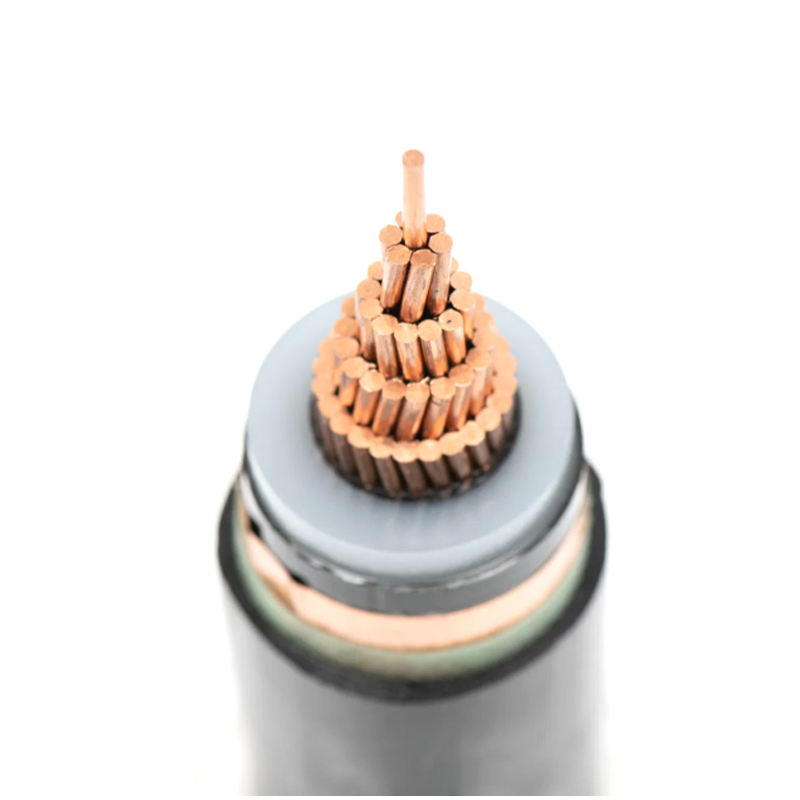
The second thing the number tells you is that this is medium voltage territory. Above roughly 1kV to 2kV, depending on which standard you are reading, two extra layers appear in the construction: a semiconducting strand shield over the conductor and an insulation shield over the insulation, usually with a metallic shield on top. Those layers exist to control electrical stress at the insulation surface. They also change how the cable is terminated, tested and installed, which is where a lot of first-time 5kV buyers get surprised.
In IEC markets the nearest equivalent is 3.6/6 kV (Um 7.2 kV), which is frequently supplied unshielded. Same physical job, two different design traditions, and a good reason to read the specification carefully before comparing prices.
| Common designation | Insulation level | Typical circuit | Shielding |
|---|---|---|---|
| 5kV, 100% level | 5.0 kV | 2.4 kV systems, short 4.16 kV runs | Shielded, single conductor |
| 5kV, 133% level | 8.0 kV | 4.16 kV feeders, airport series loops | Shielded, single conductor |
| 600V / 1kV | Not applicable | 480 V, 600 V, 690 V | Usually unshielded |
| 15kV, 133% level | 17.5 kV | 13.8 kV distribution | Shielded |
5kV is the voltage class of the 2.4kV and 4.16kV systems that were standard in heavy industry for most of the last century, and a great many of those systems are still running today. That is why the cable is still ordered in serious volumes.
Airports are a good illustration of how specific this gets. Cable for series lighting is judged on fault current withstand, moisture resistance and a jacket that survives decades in a wet duct, not on headline voltage. Projects such as Pudong International Airport sit in our own case files and are a reminder that the humble 5kV circuit often carries more operational risk than its voltage suggests.
Nonshielded 5kV cable does exist. ICEA S-96-659 covers nonshielded power cable from 2001 V to 5000 V, and in dry, indoor, mechanically protected runs with modest available fault current it works well and costs less. For anything wet, direct buried, in a long duct run, or fed from switchgear with substantial fault current, shielded construction is the safer default, and it is what most North American specifications call for at this voltage.
What the shield actually does for you:
A 5kV shielded cable is simple in concept and fussy in detail. When two quotes differ by fifteen percent, the difference is usually buried in one of these layers.
Most 5kV disputes we hear about trace back to a vague specification rather than a bad cable. Naming the standard removes the ambiguity, and it also tells the factory which test regime you expect.
One practical note on temperature. MV-105 indicates a 105°C dry conductor rating, but that rating assumes the ampacity table's ambient, burial depth and grouping. It also assumes your terminations are rated for it. Plenty of field terminations top out at 90°C, and the cable becomes the wrong half of the system if you size to 105°C and terminate to 90°C.
We go through each of these in more depth in our guide to medium voltage cable sizing, including the voltage drop and short-circuit arithmetic that trips up a lot of first-time 5kV buyers.
Outside North America, 5kV is rarely a stock item, and even inside it, lead times move around. If you are sourcing from an overseas manufacturer, a short list of questions saves weeks later: which standard the cable is built and type-tested to, whether the insulation shield is strippable, what tape thickness and overlap the metallic shield uses, and whether the jacket legend will satisfy the local inspector.
That is the part of the job we know best. Jiangsu Dongfeng Cable has been manufacturing wire and cable since 1988, and our 6-35kV XLPE power cable range is one of the core product lines, alongside 0.6/1kV power cable, 66-500kV cable, overhead and aerial insulated conductors, and specialty products. We work as a national high-tech enterprise and a national green factory, with quality control running from incoming raw material through to finished dispatch rather than being signed off at the end of the line.
 6–35kV Medium-Voltage XLPE Power Cable SeriesCustom XLPE-insulated power cable series for 3.6/6kV–26/35kV distribution, offering a PVC alternative for industrial and utility projects.View Product →
For circuits that sit just below the 6kV family, the XLPE insulated construction rated 3.6/6 kV is the one most often quoted for industrial and utility work, and it is worth comparing against your project specification before assuming a stock North American item is the only option.
 XLPE Power Cable, 3.6/6kV to 26/35kVXLPE-insulated 3.6/6kV–26/35kV cable with copper or aluminum conductors and YJV/YJY, steel-tape, or steel-wire armored variants for distribution projects.View Product →
5kV lives in a transition zone, and transition zones reward people who read the details. Get the insulation level right, decide on shielding deliberately rather than by habit, name the standard, and check the shield against the fault current. Do those four things and the cable stops being the awkward middle child and starts being the part of the project nobody has to think about again.
Your email address will not be published. Required field are marked*

Choosing our wires and cables means choosing safety, reliability, and professionalism.


 +86-17826659260
 +86-0510-87203139
 West of Huanzheng Road, Guanlin Town, Yixing City, Wuxi City, Jiangsu Province, China